What can you achieve with EMS training?

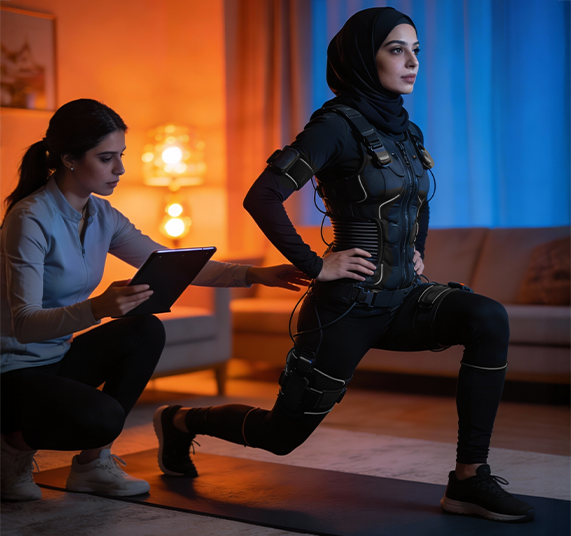
The effectiveness of EMS has been proven by numerous studies. Especially compared to conventional strength training, EMS training helps you achieve important fitness goals much faster.

After a short time, most people feel and see the results!

With just 20 minutes of training per week you can:

Weight and fat reduction

EMS promotes a high level of metabolic activity during, and for many hours after, a training session. The higher your metabolism, the better your body will burn fat and build lean muscle mass.

For women, EMS training has been proven to reduce the size of common problem areas, such as around the waist, hips and thighs. At the same time, it will firm up the chest and arms.

For men, EMS training reduces waist size, whilst developing the arm, chest, back and leg muscles.

Effects of muscle stimulation on strength capacity

EMS can produce a stronger contraction of the muscle than voluntary force development. Type 2 fast-twitch muscle fibers and core muscles have also been shown to be enhanced.

Maximum strength and endurance

Untrained individuals can only access about 40 to 70% of their strength potential voluntarily. EMS reduces this strength deficit between maximum and absolute strength, because the motor units are better synchronized and activated by EMS. Strength endurance has also been shown to increase noticeably with EMS.

Muscle building . hypertrophy

The aforementioned maximum strength gains through EMS are essentially due to an increase in muscle mass. Increases in the circumference of the chest, arms and legs are often noticeable after just a few training sessions.

Better posture, stronger back

Imbalances in the postural muscles of the back, abdomen, and pelvic floor are common ailments. With EMS, these difficult muscle groups can be targeted and effectively trained; especially in the case of the imbalance and the widespread issue of back pain – the training can make a noticeable contribution to alleviating discomfort. At the same time, compensatory bad posture is corrected, which ultimately leads to an improvement in posture and mobility.

Muscle building after operations

Several studies have shown that EMS can effectively accelerate muscle regeneration after surgery. The use of EMS in the acute phase shortly after surgery has proven to be particularly promising.

Compensation of muscular imbalances

EMS allows the targeted control of muscle groups. This is particularly important when muscular imbalances need to be compensated. Sitting at a desk for long periods of time, for example, leads to a shortening of the chest muscles with a simultaneous weakening of the shoulder and back muscles.

Performance enhancement in sports

Strength is a performance-limiting factor in many sports. EMS is ideal for building sport-specific strength, improving the quality of muscle contractions, and balancing imbalances. In addition, EMS is a time-saving alternative to conventional strength training, especially in competitive sports with its many technique and tactics specific training units (an increasingly important argument for Olympic training centres or sports clubs to cooperate with Bodystreet).

Protection of the musculoskeletal system

EMS training is “additional load free”. Training intensity with EMS does not result from heavy weights, but from electrostimulation. And that is much gentler on the joints and musculoskeletal system. In EMS training, the training intensity is generated by electrostimulation. Thus a joint-gentle training is possible without extra loads created by weights/dumbbells.